

About Course
A structured learning journey tailored to the learner’s age, confidence, and developmental stage.
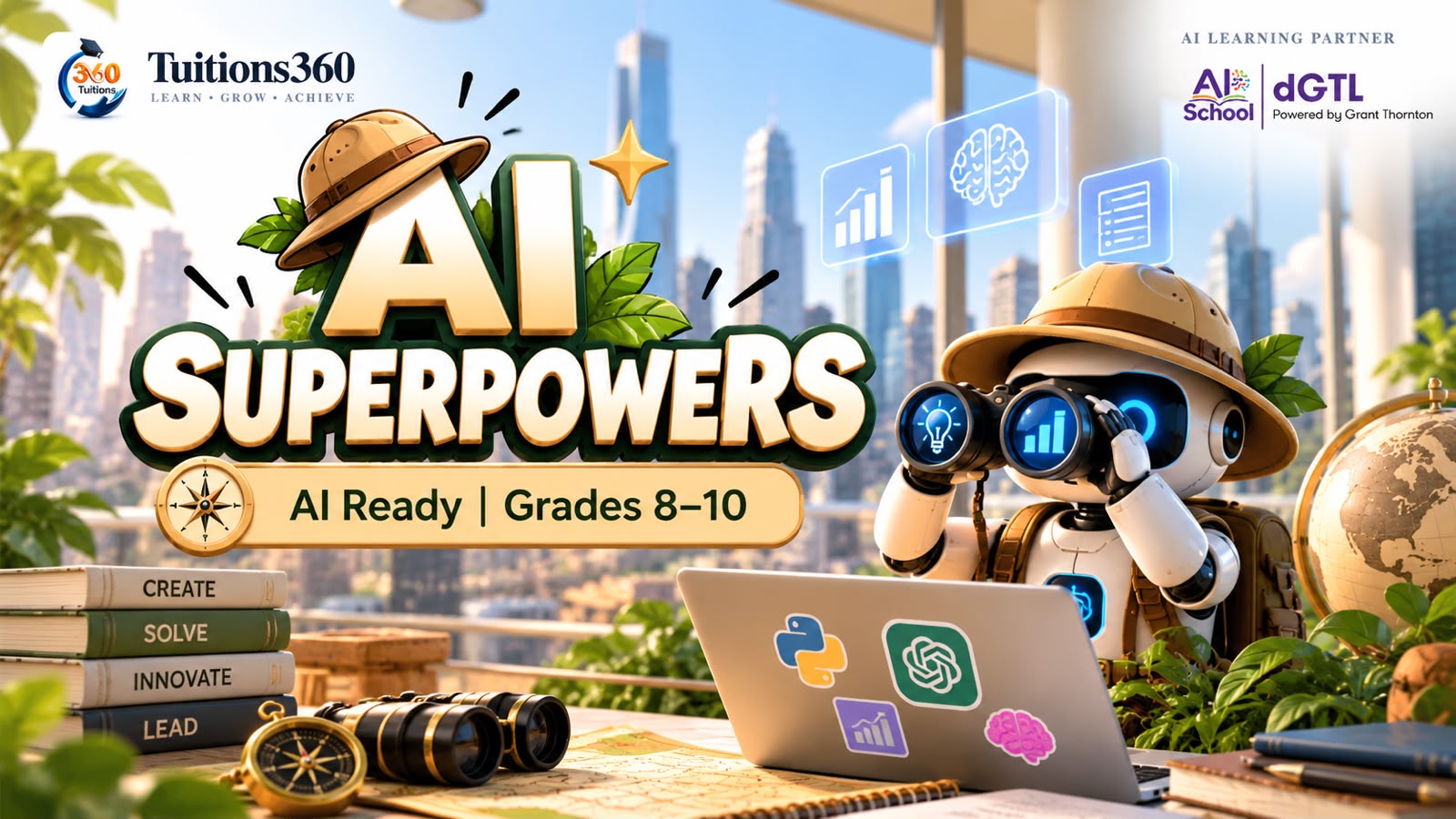
AI Ready (Grades 8–10)
Understand what AI can and cannot do, and learn to use it as a confident, curious and responsible student.
| Grade band | Grades 8, 9 & 10 |
| Duration | 32 hours of live learning |
| Structure | 4 modules – 8 sessions – 4 hours (240 minutes) each |
| Delivery | Instructor-led, live online and hands-on, with supervised digital activities, breakout discussions, collaborative work and project-based learning. |
| Who It Is For | A student’s first structured look at AI. The emphasis is on curiosity, safe exploration, useful school applications and confidence — with no coding required. |
| Entry Guidance | No coding or advanced mathematics is required. A laptop or tablet, basic internet skills and a willingness to ask questions are enough. |
| Student Outcomes | A personal Prompt Journal, three finished AI-assisted school/creative projects, a completed AI Ground Rules card and a short portfolio presentation. |
| Certification | Certificate — AI Ready |
Common learning foundation
Depth increases as students progress, but the programme consistently reinforces six connected areas:
| AI Foundations What AI is, how it works at a conceptual level, and where it can go wrong. | Learning with AI Using AI as a study partner that supports thinking rather than replacing it. |
| Studying with AI Exam preparation, note-making, explanation and structured revision support. | Creating with AI Images, stories, audio, video and projects that remain human-led and properly acknowledged. |
| Agents & Automation Simple AI tools and mini workflows that extend what a student can do. | Ethics, Safety & Responsibility Bias, privacy, misinformation, originality and digital wellbeing built into the learning journey. |
What makes the programme distinctive
Industry-informed learning — Students experience professional habits such as problem framing, research, tool selection, peer feedback, quality checks and presentation — adapted for a school environment. Real outputs — Every module produces something students can keep, improve and share. Verification-first mindset — Students learn to question, test and verify AI output rather than simply accept it. Human-led learning — AI is treated as a support tool; students remain responsible for their ideas, decisions, originality and learning.
How the Programme Is Delivered
Live, online and hands-on — with a deliberate balance between guided instruction, independent practice and collaboration.
A consistent learning rhythm
- Explore Start with a relatable question, example or challenge.
- Try Students use the concept or tool in a guided activity.
- Question Students compare outputs, identify limitations and discuss choices.
- Build Students create a tangible piece of work.
- Reflect & Share Students explain what they learned, what they changed and how they used AI responsibly.
Course Completion
Build AI literacy, safe habits and confidence through guided exploration, learning and creativity.
- Course – AI Ready
- Student of Class VIII-X
- AI Certification
What Students Complete –
- Prompt Journal with tested prompts across school subjects.
- Three completed AI-assisted school or creative projects.
- AI Ground Rules card covering honesty, privacy and responsible use.
- Short portfolio presentation explaining the work and how AI was used.
What Students Can Demonstrate –
- Understand what AI is and where it appears in everyday life.
- Use AI to support learning, research and creativity while checking its outputs.
- Write clearer prompts and build safe, honest AI habits.
- Create and explain a small portfolio of AI-assisted work.
What the Certificate Represents –
- Portfolio-backed — Evidence comes from work completed during the course.
- Showcase-based — Students demonstrate their learning through a presentation.
- Skills-focused — Evidence covers responsible AI use, research, creation, verification, project work and communication.
Course Content
Module 1 — Meet AI
-
Session I – AI Around Us
-
Session II – How AI Thinks
Module 2 — Smart Prompting & Responsible AI Use
Module 3 — AI for Learning & Creativity
Module 4 — My AI Toolkit & Showcase
Student Ratings & Reviews